
Playing the piano is a fun and rewarding experience. The benefits for your health and brain have been proven by many scientific studies. However, beginners occasionally struggle with the mental and physical pursuit of getting started.
Whether you’re a professional or a hobbyist, there’s no one-size-fits-all model for success. But there are a few critical practice tips that everyone can apply to make a real difference in their piano playing. If you’re an aspiring pianist having a difficult time improving your piano skills, remember, you’re not alone.
Here are 5 tips to help you improve.
1. Break Down Difficult Passages Into Small Sections.
Taking things slow when you first start out is essential for good playing. Break piano pieces up thoroughly and work diligently on small sections until you achieve the right tone and rhythm. Mark difficult passages and work on them separately.
Listen very closely to your playing and try to pinpoint any uneven parts. Practice these as many times as you can to strengthen your weaker fingers. If you feel any tension in your hand, though, stop immediately and take a break.
2. Practice with a metronome.
Once you have mastered the tone and rhythm in slower sections, use a metronome in harder passages to gradually speed it up. This can help you develop the muscle memory and strength you need to play the part at the intended speed. It can also help you practice timing and tempo, and adjust your playing in accordance with the time signature. If there’s unevenness, make sure you go back to the first practice tip and get it right.
This is particularly important for pianists as you need to master each hand’s part and the combination together. Many teachers will recommend working on each hand in isolation until you reach the target tempo (or even faster) before going back to slow practice, both hands together.
3. Master Scales and Technical Exercises.
Practicing musical scales for each key signature isn’t very exciting, but it’s an important skill in piano playing. This will help you nail down your fingering habits and get a better sense of what notes are in each key.
Having a strong foundation in understanding the scales will help you when you’re ready to start improvising. The more you know about note and key relationships, the easier it will be to simply choose a key and make up a tune as you go.
4. Find efficient fingering.
If you are a novice, don’t be ashamed to write in the fingering on the score to help you learn it properly. This will aid in smoother playing and is very important for more complicated passages.
Practicing different scales is crucial so you know which fingers to use without having to think about it. Always remember to cross your thumb under your third finger to negotiate all the notes when playing scale-type passages (with a couple of exceptions, such as the F major scale).
5. Take Regular Breaks to Optimize Learning.
Piano players often wonder how much practicing should be done per day. But what matters more is the quality of the practice. You should organize your practice time so you have a sense of purpose and direction, as well as a way to measure your improvement. Since piano playing is mentally and physically exhausting, over-practicing can actually slow down your progress.
When you keep making the same mistake in the same spot over and over, take a break. Go for a walk. Eat something. Do a little stretching. You’ll notice that after a few hours, you’ll find it easier to concentrate again and that little problem spot might just disappear.
Ready to go beyond these 5 simple tips? Read on and let’s dive in…
Common Piano Practice Mistakes Beginners Should Avoid

When you’re learning piano, it’s easy to develop habits that can actually slow your progress. Many of these stem from how you approach mistakes and challenges. Here are some common pitfalls that beginners should watch out for:
Rushing past your mistakes
One of the biggest mistakes beginners make is moving on too quickly when something goes wrong. When you hit a wrong note or stumble through a passage, the natural instinct is to keep going and hope it gets better. But this approach means you miss out on valuable learning opportunities. Try not to just “jump away” from a mistake – pause and examine what happened. Choose segments where you have particularly troublesome spots and spend time understanding why the mistake keeps happening. This deliberate focus on problem areas is what separates rapid improvement from spinning your wheels.
Avoiding your weak spots
Related to rushing past mistakes is the tendency to avoid difficult passages altogether. You might find yourself tending to just play through the parts you’re already good at because they feel satisfying, while glossing over the sections that give you trouble. The solution is counterintuitive: make the mistake on purpose. By deliberately practicing the spots where you keep making the same mistake over and over, you can break down exactly what’s going wrong and build the muscle memory to get it right.
Being intolerant of imperfection
Beginners often expect perfection too soon and get frustrated when they make mistakes. This frustration can actually slow down your progress. Learning piano requires you to tolerate mistakes as part of developing the skill. Remember that we all make mistakes when learning something new! And quite soon you’ll find yourself looking back at music you once found incredibly challenging with ease. Give yourself permission to be imperfect while you’re learning.
Making negative facial expressions
Strange but true: making faces when you make a mistake can actually impact your success . When you frown, flinch, or show your frustration physically, you’re reinforcing negative associations with your practice. This might seem minor, but it has a huge impact on helping you reach your goals. Stay neutral and positive in your physical demeanor, even when things aren’t going perfectly.
Not having recovery strategies
Many beginners think that any “wrong” note is a disaster that ruins everything. But experienced musicians know how to recover gracefully. You can learn strategies to quickly turn any wrong note into something that sounds great. This might even convince your listeners you did it on purpose! So rather than panic when something goes wrong, develop the skills to transform “mistakes” into interesting (even beautiful!) music.
The bottom line on mistakes
The common thread in all these mistakes is how you relate to errors in your playing. Beginners who struggle often see mistakes as failures to be avoided at all costs. But mistakes can truly be your friends in the learning process. They simply reveal where you to focus your attention. They highlight weak spots that, once strengthened, will level up your entire playing. And they’re an inevitable, essential part of becoming a skilled pianist.
As you practice, try to cultivate more curiosity about your mistakes than frustration. When something goes “wrong”, get interested in why it happened. When a passage gives you trouble, try your best to actively lean into it. And remember that all musicians (even professionals) make mistakes. The only difference is whether you’ve learned to work with them or continue fighting against them.
Build and Maintain Your Piano Repertoire
Having a solid practice repertoire is one of the most powerful tools for improving your piano skills. Many pianists make the mistake of either tackling pieces that are far too challenging or jumping from song to song without building a core collection of pieces they’re actively developing. Your repertoire should be a carefully chosen set of pieces that keeps you motivated, reveals what you need to work on, and gives you clear answers to the question “Why am I practicing this?”
Choose Pieces That Are Within Your Reach
The key to building up your repertoire is finding music that sits in a “sweet spot” – pieces that feel exciting and beautiful, but are technically within your reach so you can make serious progress in one or two weeks’ time. This is transformational for your practice because it keeps you motivated while allowing you to focus on bringing your own musicality to the piece.
It’s common for beginners to want to play very challenging, technically demanding pieces. However, choosing simpler repertoire doesn’t mean you’re not progressing. When you pick something less complex, you can still take great steps forward by playing it with intention and expression, really bringing your whole musicality to it. The goal is to find music that allows you to succeed while still challenging you in meaningful ways.
Let Your Repertoire Guide Your Technique Work
One of the best ways to use repertoire is to let it reveal what technical skills you need to develop. When you start learning a piece, you’ll inevitably encounter sections you can’t play yet. Instead of getting frustrated, let these moments guide your technique practice.
For example, suppose you choose a piece that’s not impossible for you, but you know will push your limits. As you start to work through it, you discover specific challenges. Maybe you can’t play a particular bar because your hands can’t execute a certain pattern fast enough. That’s your cue to focus on that specific technique.
This is much more motivating than randomly working through technique exercises. When you have a real piece as your goal, you have a clear answer to “Why am I spending time on this technique?” Instead of running through technical exercises for their own sake, you’re learning what you need to play the piece you actually want to play . By learning one well-chosen piece, you’ll also learn a lot about your instrument, and the style that other similar pieces are written in, giving you transferable skills.
Maintain Multiple Pieces at Different Stages
An efficient practice repertoire will include multiple pieces at various stages of development. This variety keeps your brain engaged and your practice sessions fresh. You might have one piece you’re actively learning, another you’re refining for expression, and a couple more you’re using for retrieval practice.
For example, a well-rounded practice session might include working on phrasing in one piece, doing a retrieval practice run-through of a piece you’ve been learning (playing it once without stopping, even with mistakes), and starting active listening for a new piece you want to add. This interleaving approach – switching between different pieces and different types of work – keeps practice engaging and helps your brain make connections.
Building and maintaining your repertoire can be about intentionally choosing music that inspires you, using those pieces to level up your instrument skills, and keeping multiple pieces alive at different stages. This approach ensures you always have a clear purpose in your practice and a steady path to becoming the pianist you want to be.
Set Up Your Practice Space for Success
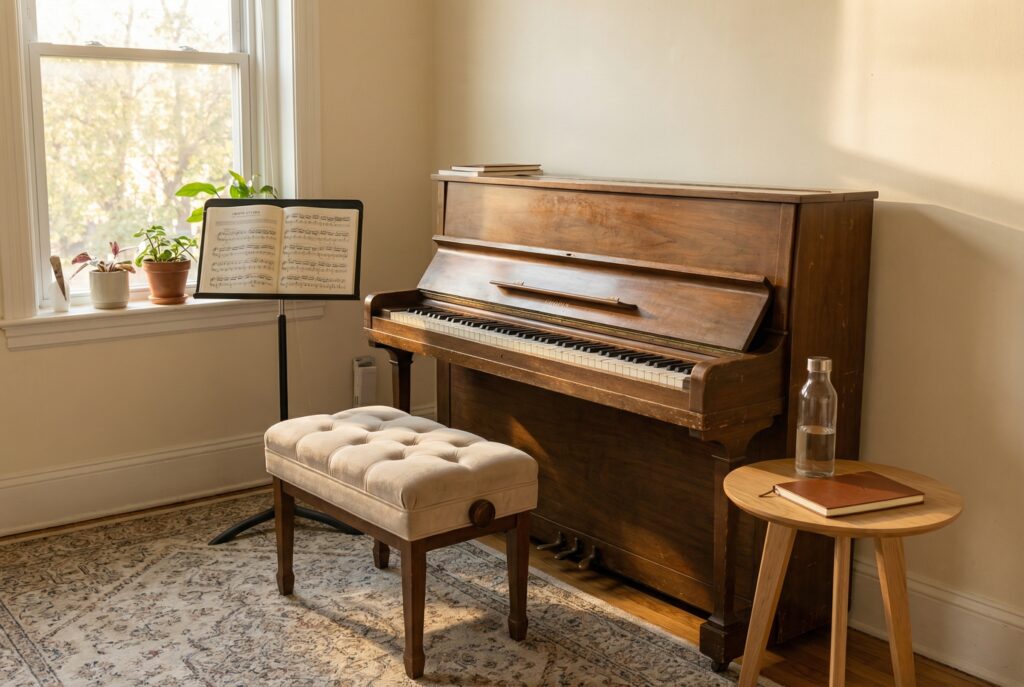
Before you dive into scales and finger exercises, take a moment to think about where you practice. Your environment can make a real difference in how effectively you learn and how well your skills translate to actual performance situations.
One of the most important things to understand is that practice and performance are two different experiences. When you practice, you’re breaking things into chunks, stopping to correct mistakes, and working on small sections repeatedly. But when you perform, you need to link everything together and keep going no matter what happens. Your practice space should help you master both of these skills.
Consider setting up your practice area to mirror your performance goals. If your dream is to perform in a specific type of setting, you can recreate elements of that experience right in your practice space. This approach, called Direct Practice, can be surprisingly effective. For example, if you want to perform for audiences, set up your piano space with the right bench or stool, position it the way you would on stage, and even adjust the lighting to match performance conditions. You might feel silly at first, but this kind of targeted setup helps your brain and body get comfortable with the real thing.
You don’t have to go to extremes to benefit from this principle. Even small adjustments matter. And don’t hold yourself back from playing the music you really want to play because you think you aren’t “ready”. Sometimes diving in and giving it a good try in a realistic setup helps you make progress faster than endless isolated technical drills.
Your practice space should also support consistent habits. The important thing for building reliable skills is consistency, not perfection. If your practice area is comfortable and inviting, you’re more likely to show up day after day. Choose a spot where you can leave your piano set up and ready to go, rather than having to move things around every time you want to practice. The easier you make it to start, the more likely you are to maintain a regular routine.
Pay attention to how long you practice in one session. One of the biggest mistakes you can make is to spend too long at the piano without a break. Your ears fatigue, you stop hearing what you should, and you’ll almost certainly end your session frustrated. Practice only until your ears start to feel tired or you feel you’re not making progress, then take a break. Your practice space should support this rhythm. Maybe you have a comfortable chair nearby where you can relax for a minute or two, or you can set up near a window where you can look outside and reset between focused sessions.
Believe it or not, your practice environment extends beyond the room where spend time at your piano or keyboard. For your skills to improve, time spent sleeping is just as important as time spent practicing. Your brain needs regular and adequate sleep to consolidate what you’ve learned. So while you might be tempted to stay up late squeezing in extra practice, remember that getting enough sleep is actually vital to see the benefit from practice time.
Finally, think about how your practice space integrates with your musical life as a whole. Your practice routine shouldn’t exist in isolation. It needs to work alongside your lessons, theory study, and any group activities you’re involved in. Make sure your space has room for sheet music, theory books, or any other materials you need to bring all aspects of your musical development together in one place.
So your practice environment matters more than you might think. With a few thoughtful adjustments, you can create a space that supports both focused technical work and realistic performance preparation, making every practice session more productive and enjoyable.
Practice Difficult Passages Along With Easy Ones
It’s tempting to spend most of your practice time drilling the hardest passages over and over while breezing through the sections you’ve already mastered. But this approach can actually slow down your overall progress and prevent you from developing the smooth, confident playing you’re aiming for.
When you focus exclusively on difficult passages, you risk creating an uneven performance where some sections are over-rehearsed while others become rusty. More importantly, you miss out on the crucial skill of transitioning smoothly between easy and challenging parts—which is exactly what you’ll need to do when performing the complete piece.
Here’s a better approach: organize your practice to give appropriate attention to passages at all difficulty levels.
Categorize Your Passages
Start by identifying which sections of your piece fall into different categories. Play through your piece and mark each passage as:
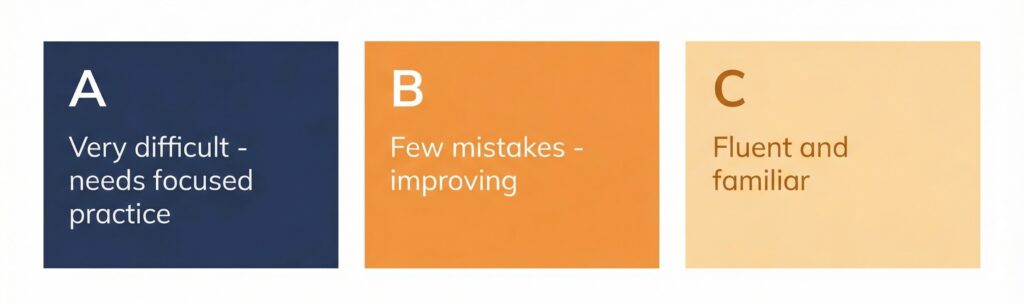
- Category A: Still very difficult and needing focused, deliberate practice
- Category B: Can play through with perhaps a few random mistakes
- Category C: Quite fluent and familiar
This simple assessment helps you see the full picture of where your piece stands and prevents you from neglecting sections that are “good enough” but not performance-ready.
Apply the 80% Rule
One of the most liberating concepts for piano practice is that mastery of each passage isn’t necessary before you move forward. In fact, allowing yourself to be flexible will typically accelerate your training by letting you work around obstacles and sticking points.
Aim for about 80% accuracy—meaning “I normally get it right”—before shifting your focus to other passages. When you return to those problem spots later, you’ll often find that your improved overall skill has already removed much of the difficulty.
This doesn’t mean giving up on challenging sections. It means being strategic about when and how much time you invest in them during each practice session.
Balance Your Practice Time
Once you’ve categorized your passages, divide your practice time deliberately. Category A passages need slow, careful work—the kind of deliberate practice where you break things down and repeat small sections. But don’t let these passages monopolize your entire session.
Category B and C passages deserve regular attention too. These sections benefit from what’s called retrieval practice—playing them through to maintain and strengthen what you’ve already learned. If you only practice the difficult parts, your once-solid sections will deteriorate.
Practice Transitions
One aspect many pianists overlook is practicing the transitions between passages of different difficulty levels. Your hands and mind need to navigate smoothly from sections that feel easy into passages that require more concentration, and back again.
This is similar to how singers learn to smoothly pass between different vocal registers—it’s not about perfecting each register in isolation, but about the gradual transition between them. For pianists, this means occasionally running several sections together, even if the difficult middle passage isn’t yet perfect.
Avoid the Practice Rut
If you find yourself feeling stuck or frustrated while working on a particularly difficult passage, remember that moving on to something else can actually accelerate your overall progress. Be persistent and patient with yourself—it does take time and repetition to teach your muscles and brain new skills—but don’t fall into the trap of endlessly drilling the same few measures.
Your practice session should have variety and flow, touching on passages at different difficulty levels. This approach keeps you engaged, prevents burnout, and develops the well-rounded skill set you need for confident, musical performance of the complete piece.
For aspiring pianists, these tips can help you make the most of your practice time. If you follow these guidelines and work on your piano skills consistently and diligently, you’ll be amazed at your rapid progress.
Are you finding it hard to improve your piano playing skills and bring your pieces to life? Do you need help figuring out more effective practice techniques? Join Musical U today to master your practice habits and achieve your musical goals.